
You are welcome to browse the full issue here.
Author: AALITRA
-

Self-Translation, Issue 22 of The AALITRA Review
The AALITRA Review’s theme for its issue nr. 22 (2026) is Self-Translation.
Self-translation challenges the established binary between author and translator: as per Anton Popovič’s early definition, self-translation is ‘the translation of an original work into another language by the author himself’ (1976, 19). For Susan Bassnett (2013), self-translation also challenges the notion of originality, in both senses of the word. Such practice requires of the self-translator to balance accuracy and truthfulness to the source text, while drifting towards recreating it in parts or in whole. Another favoured binary in Translation studies, the distinction between start text(s) and target text(s), becomes rather blurred, and inoperative. Think of Samuel Beckett, whose self-translations were akin to acts of rewriting. Ilan Stavans (2018), who lives and writes in four languages and practices translation and self-translation, confesses: ‘I exist in an echo chamber of self-translated voices, all of them my own.’ As Anthony Pym (2020) puts it though: self-translations ‘tend to be remarkably free and creative (Samuel Beckett is the prime example), since it is difficult to betray oneself’. The self-translator can’t not be true to the author.
Practices of collaborations between an author and their translator may lead to such a large input of the author-as-self-translator as to backfire on the start text: a case in point is Borges and his translator Norman Thomas di Giovanni, who ended up inciting Borges to alter his writing to fit the translation.
For his part Rainier Grutman (2013) distinguishes ‘At least three categories of self‐translators whose linguistic repertoire is characterized by […] asymmetry: (1) “(post)colonial” writers who alternate between their native tongue(s) and the European language of the former colonial powers; (2) recent immigrant writers who expand on work begun in their home country […]; (3) writers belonging to traditional linguistic minorities’.
Some theorists go as far as consider ‘the act of self-translation as a potential tool to restructure the domain of translation studies’ (A.K. Ajeesh & R. Pranesh Kumar, 2019). There is a still much to discover in the theory and practice of self-translation.
This is the reason why The AALITRA Review is calling for contributions relating to the act of self-translation. Contributions may take the form of articles, or Translations with commentary analysing authors’ own self-translations, or existing ones, not limited to the well-known self-translators like Graham Green, Vladimir Nabokov, Nancy Huston, Jorge Semprun, or Ariel Dorfman. Interviews or Diaries of self-translators are more than welcome.
Send your Expression of Interest (Abstract) by the end of November for submission of full-length paper by 13 February 2026 to : aalitra.review@gmail.com or helene.jaccomard@uwa.edu.au
Calendar:
Send your EOI (Abstract) : November 2025
Submissions of full-length paper: 13 February 2026
Response to authors [after assessment]: 1 June 2026
Authors revisions: 14 August 2026
Publication : November 2026
Indicative Bibliography :
A.K. Ajeesh & R. Pranesh Kumar (2019) Self-translation as an effective tool to restructure the domain of Translation Studies, Self-translation as an effective tool to restructure the domain of Translation Studies. December 2019,
IUP Journal of English Studies, https://www.researchgate.net/publication/337244579_Self-translation_as_an_effective_tool_to_restructure_the_domain_of_Translation_Studies
Susan Bassnett (2013), “The Self-Translator as Rewriter.” In Anthony Cordingley (ed) Self-Translation: Brokering Originality in Hybrid Culture, Bloomsbury, pp. 13–26.
Anthony Cordingley, ed. (2022) “Self-Translation: Brokering Originality in Hybrid Culture”, The Cambridge Handbook of Translation [2013], pp. 75 – 95.
Rainier Grutman (2013), “Beckett and Beyond: Putting Self-Translation in Perspective”,Orbis Litterarum 68(3) DOI: 10.1111/oli.12022
Anton Popovič (1976) Dictionary for the Analysis of Literary Translation. Edmonton: University of Alberta.
Anthony Pym (2020). “Literary Translation”, in J. Frow (Ed.) Oxford Research Encyclopedia of Literature. https://doi.org/10.1093/acrefore/9780190201098.013.1107. Reprint in J. Frow (Ed.) (2022) The Oxford Encyclopedia of Literary Theory.
Ilan Stavans (2018) On Self-Translation: Meditations on Language. State University of New York Press, 2018. Project MUSE, https://dx.doi.org/10.1353/book.100027.
-

SYMPOSIUM 9 October 2025, organised by AALITRA and CO.AS.IT
Translation, Voice, and Identity: A Symposium
Thursday 9 October, 2025 @ 5–8 pm
CO.AS.IT (Italian Assistance Association)
199 Faraday Street, Carlton
Translation plays a vital role in promoting cultural exchange; but in that role, it is sometimes subject to constraining and distorting forces. Speakers will present papers examining how translation shapes and reshapes “voice” and “identity”.
Frances Egan
(Re)translating Colette: reflections on gender and performance
How does Colette sound – look? – in 21st-century English? A shapeshifter herself, Colette took to the stage and wrote autofiction avant la lettre. Her work and persona have been reimagined countless times: through previous translations, as well as through performances by figures from Algerian-born Polaire to Keira Knightley and the anonymous dancer on the cover of my forthcoming translation. In this talk, I reflect on inhabiting Colette’s world and interpreting her voice anew in my translation of La Vagabonde (OUP, September 2025), with particular attention to shifting notions of feminism, gender, embodiment, and identity.
Frances Egan is a translator and lecturer in the School of Languages, Literatures, Cultures and Linguistics at Monash University. She has published widely on representations of gender, culture and feminism in the French and Francophone context.
Marko Pavlyshyn
The Translation Front: Reflections à propos of Russia’s Invasion of Ukraine
In a war that is essentially about the right of a culture and a national identity to exist, what role can, should, and does literary translation play? I make observations about trends in the publication of mainly English-language translations of Ukrainian literary works since 2014 and especially since 24 February 2022; I remark on translators’ and publishers’ motivations and choices as they offer Ukrainian works to their readerships; and I speculate about the potential efficacy (or otherwise) of translation as a vehicle for influencing public attitudes to Ukraine and the war.
Marko Pavlyshyn is Emeritus Professor in the Mykola Zerov Centre for Ukrainian Studies in Monash University’s School of Languages, Literatures, Cultures and Linguistics. His research specialisations include modern and contemporary Ukrainian literature, post-colonial approaches to the study of Slavic literatures and cultures, and issues of culture and national identity. He was the founding President of the Ukrainian Studies Association of Australia.
Stephen Regan
At the Green Bar: Ciaran Carson’s Irish French Sonnets
In 1998, the Irish poet Ciaran Carson published a remarkable set of translations of late nineteenth-century French Symbolist and Decadent poetry with unmistakably Irish nuances and allusions. Attracted by the twelve-syllable line characteristic of the French sonnet, Carson composed The Alexandrine Plan, a book of bold and provocative versions of poems by Charles Baudelaire, Stéphane Mallarmé and Arthur Rimbaud. This paper will look closely at the stylistic versatility and ingenuity with which Carson crosses the French sonnet with old Irish poetic forms such as the aisling. It will argue that Carson’s translations effectively retain the yearning isolation and confessional candour of their Symbolist precursors, while also enjoying liberties of expression and ostentatiously declaring their Irishness.
Stephen Regan is a Research Associate in English and Theatre Studies at the University of Melbourne. His publications include Irish Writing: An Anthology of Irish Literature in English 1789-1939 (Oxford, 2004) and The Sonnet (Oxford, 2019). His essays on modern poetry have appeared in The Cambridge History of English Poetry (2010), The Cambridge Companion to Twentieth-Century English Poetry (2008), and The Oxford Handbook of Modern Irish Poetry (2012). He is co-editor, with Andrew Motion, of the Penguin Book of Elegy (2023).
-

A conversation between Elaine Lewis and Kerry Mullan, 17 September 2025
Following the AALITRA’s AGM, Elaine Lewis presented her book ‘Left Bank Waltz: The Australian Bookshop in Paris’ (Penguin), and shared many fascinating stories of her long life as a cultural ambassador between France and Australia.
Thank you Elaine for being such a supporter of AALITRA!
-

‘Je ne regrette rien’: An evening with AALITRA’s own Elaine Lewis
An evening with AALITRA’s own Elaine Lewis, a woman of many talents and stories, in conversation with good friend and collaborator on a host of matters French, Kerry Mullan.’
📅 6:30 – 7:15 pm AEST, Wed 17 September
🌐Mode: Hybrid
📍Location: Linkway Meeting Room, Level 4, John Medley Bldg, University of Melbourne, Parkville, VIC, 3010 (Link to map here)
🔗Zoom link: https://unimelb.zoom.us/s/88026702220This event will be preceded by AALITRA’s AGM (5:30 to 6:30).It is a free event, but we encourage you to register. You can do so here. -

“No Island is an Island: Literary Translation in Australia”, 12 September 2025, Emerging Writers festival
Sponsored by AALITRA in collaboration with AUSIT and EMF, don’t miss this free event featuring AALITRA committee members: Laura Fritch, Nadia Niaz and Brigid Maher as participating Chair.
Date: 12 September 2025 @ 6pm
Venue: narrm ngarrgu Library and Family Services, Bagungga (Reading & Events Space, Level 1)
141 Therry St, Melbourne VIC 3000 -

Check the ‘Other Events’ page!
In the ‘Other Events‘ page we collect Australian and worldwide announcements and information regarding Literary Translation, such as new publications, journal articles, prizes and awards. All stuff that will be of interest to AALITRA members and our website visitors.
Browsing this page, you might find you are eligible for a poetry prize, or don’t want to miss a super interesting Literary Translation webinar!
-

*New*: Mid-year Spotlights, The AALITRA Review
To give our readers some food for thoughts until the next issue of The AALITRA Review is released, we highlight here some excellent pieces from past volumes.
We selected four pieces, all dealing in their different ways with the notion of Global Literature and Translation.
-

Become an AALITRA member or renew your membership today!
Join AALITRA now to receive news of upcoming AALITRA and other literary translation events.
As a member you may inform us about your latest translations here. We will advertise them on the Members’ Translations page.
Please complete our membership form by clicking here.
-

Found in Translation: Translation Slam with Mariana Enríquez, Melbourne Writers Festival (MWF)
11 May 2025 @ 13:30, State Library of Victoria, Conversation Quarter
Here are some highlight quotes from audience members about the Slam, which were submitted in response to MWF audience survey. For reference, around 25 people mentioned the Translation Slam in the audience survey, with many suggesting MWF program similar events in the future.
“My favourite moment from the festival was The Translation Slam with Mariana Enriquez – absolutely fascinating to see two translations side-by-side.”
“I really enjoyed the translation slam with Mariana Enriquez. I don’t speak Spanish, but the discussion with the translators felt like a really unique way of hearing a reading, and the discussion between the author and the translators was so fascinating.”
·”I sat through the translation slam and developed a rubrik for briefing translators for my work.(I self publish).
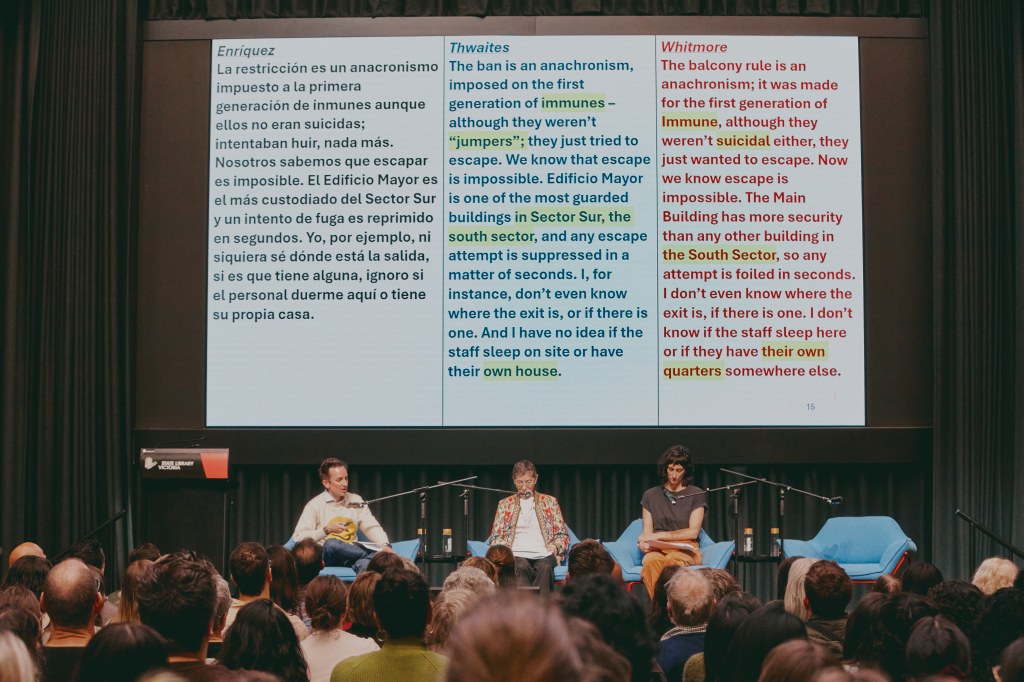
The powerpoint presentation of the event is now available as well as the audio file:
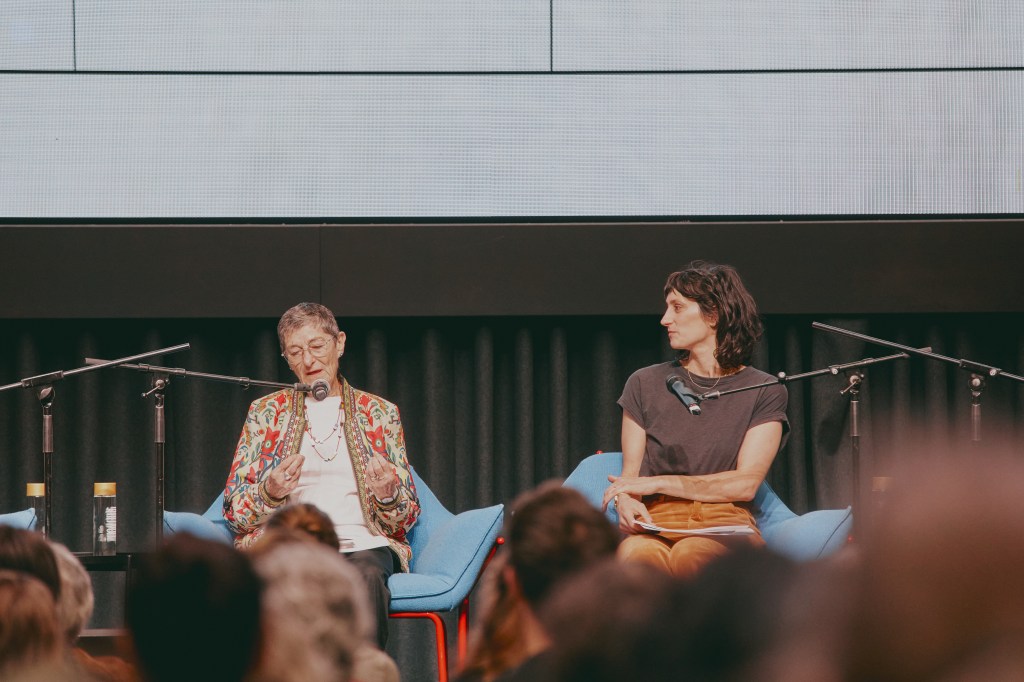
Translators Lilit Žekulin Thwaites and Alice Whitmore went head-to-head, each translating the same excerpt of Mariana Enríquez’s work. They defended their choices, revealing the intricacies of translation, while Enríquez reflected on being translated.

-
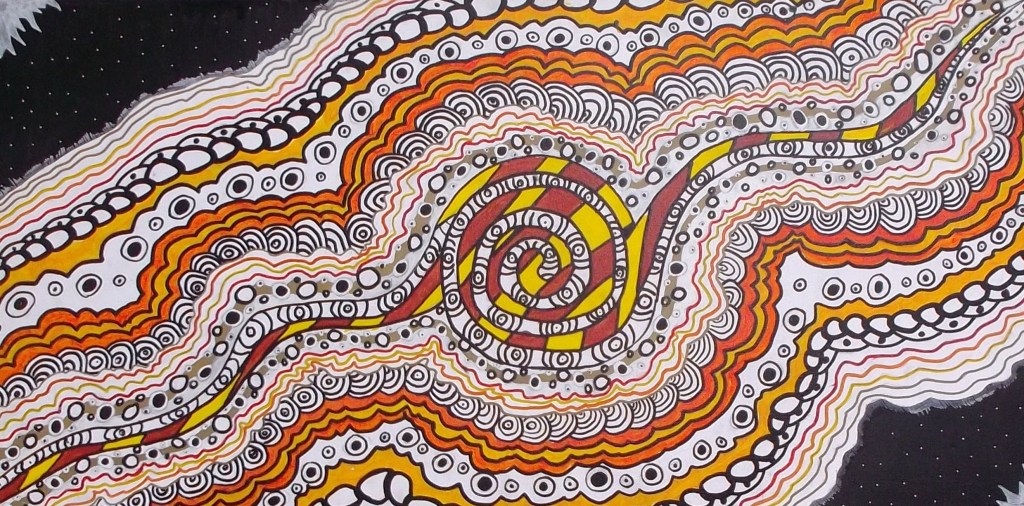
The latest issue of The AALITRA Review is now available
Vol. 20 (2024) theme is Exploring Indigenous Australian literature in other languages
Indigenous Australian literature started gaining international attention in the late 1970s, when works written by Indigenous authors from Australian and New Zealand began to be translated into various languages (Čerče & Haag 2013), including English which often acted as a source text for translations into LOTEs (languages other than English). These works have played an important role in promoting and advocating for the rich culture and history of the Aboriginal and/or Torres Strait Islander peoples. The AALITRA Review is launching a special issue to promote and celebrate their vibrant cultures, languages and traditions.
The issue also includes non-thematic contributions: one theoretical article, translation & Commentary of a Chinese chronicle, a Russian autobiographical prose, a French poem, two book reviews and, for the first time, a Translator’s Diary, which is a new type of submissions we called for this year. The inaugural diary is by eminent French into English literary translator, Emeritus Professor Brian Nelson.
We are also very pleased to publish two of this year’s winning AALITRA translation awards: a poem in French by Marilyne Bertoncini translated by Heidi Bula and Shiva Motlagh- Elbakri into English.
-
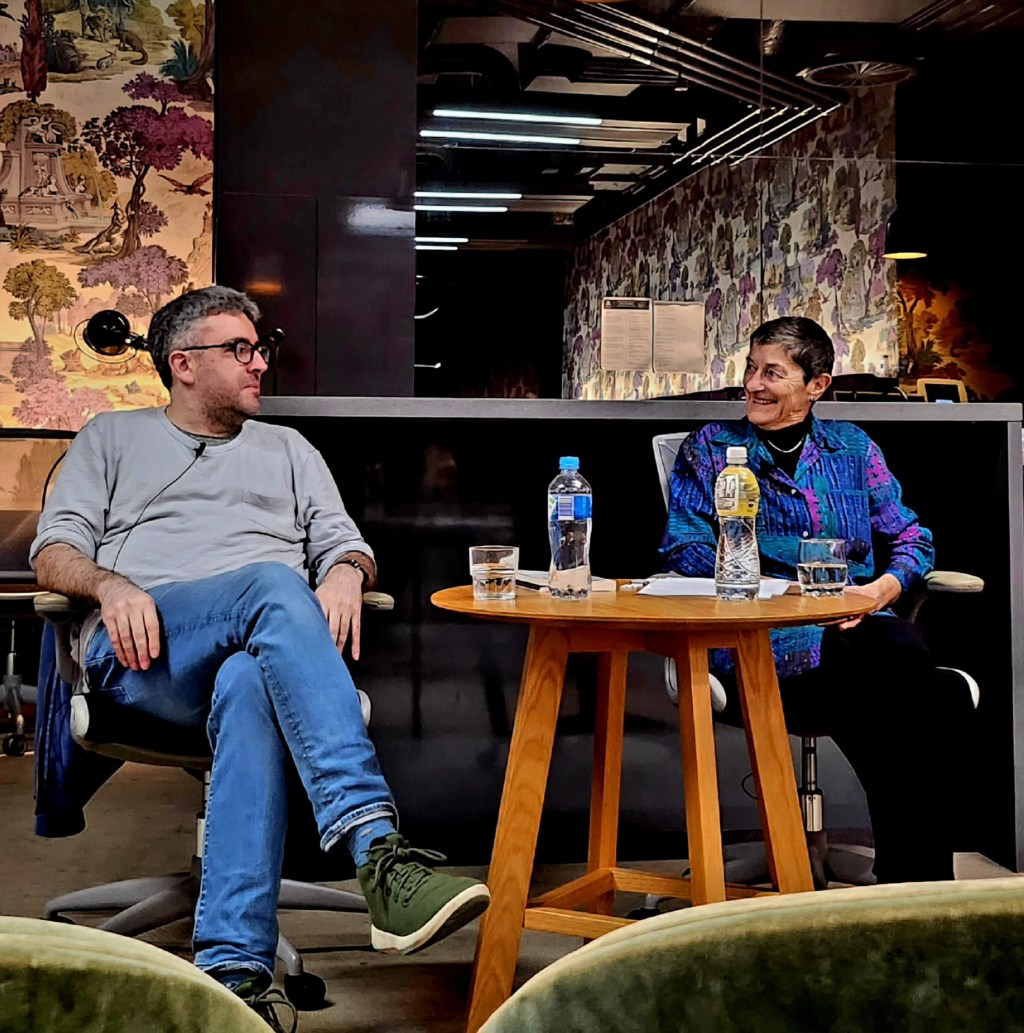
A CONVERSATION
Challenging Words:
A Conversation Between Translator & Author Daniel Hahn & Lilit Thwaites [Recorded]📅Date: Thursday, 9 May 2024 ⏰Time: 6:00 PM – 7:30 PM
📍 Venue: The Research Lounge, Level 5 Arts West, Room 552, University of Melbourne, Building 148B (directions here)

Photo © John Lawrence, 2015
Daniel HAHN OBE is an award-winning writer, editor and translator with about a hundred books to his name. Recent books include Catching Fire: A Translation Diary, and translations of work by Gonçalo M. Tavares and Juan José Millás. He is a past chair of the Society of Authors (the writers’ union of the UK) and the Translators Association, and serves on the board of a number of organisations working with literature, literacy and free expression. He is one of the editors of the The Ultimate Book Guide, a series of reading guides for children and teenagers, and the author of Happiness Is a Watermelon on Your Head, a picture book for children. He is currently compiling a collection of Brazilian short stories, translating a Colombian classic and writing a book about Shakespeare. https://www.danielhahn.co.uk/ 
Lilit Žekulin THWAITES is an award-winning Australian literary translator (Spanish>English), an Adjunct Professor in contemporary Spanish literature at La Trobe University, and current President of the Australian Association for Literary Translation (AALITRA). Her book translations include the bestselling The Librarian of Auschwitz, Australian Connection , and two futuristic novels by Rosa Montero, Tears in Rain, and Weight of the Heart. Her translations of short stories, essays and poetry have been published in journals and anthologies. She presents sessions at writers’ festivals, gives talks about Spain and translation, and helps organise visits to Australia by Spanish-speaking writers. She is currently translating Luisa Etxenike’s Cruzar el agua. In 2016, she received Spain’s Cross of the Order of Civil Merit for her promotion of Spain’s literatures and cultures in Australia. -
Languages & Cultures Network for Australian Universities (LCNAU) Researchers Database
Please see the link to the LCNAU database below:
https://docs.google.com/document/d/1Mu5WaAooAe1CTj5hjp3gbw-vau1QCyqjTkld3_Eu0KM/edit


 aalitra.org.au
You must be logged in to post a comment.